How to Write a Home Inspection Report (Complete 2026 Guide)
How to Write a Home Inspection Report (Complete 2026 Guide)
Your home inspection report is the most important deliverable in your business. It protects your clients, builds your reputation, and drives agent referrals. This guide covers everything you need to write professional, thorough reports that set you apart from the competition.
Why Your Home Inspection Report Matters More Than You Think
A home inspection report is far more than a checklist of defects. It is a legal document, a communication tool, and the single biggest factor real estate agents consider when deciding which inspector to recommend. According to industry surveys, over 80% of inspection business comes from agent referrals, and agents consistently rank report quality as their top criteria after professionalism.
A well-written report protects you from liability claims, helps your clients make informed decisions, and positions you as a trusted expert. A poorly written one can lead to lawsuits, lost referrals, and a damaged reputation.
Whether you are a new inspector writing your first report or a veteran looking to sharpen your skills, this guide will walk you through every aspect of producing reports that are clear, professional, and thorough.
What Is a Home Inspection Report?
A home inspection report is a written document that describes the condition of a property's major systems and components based on a visual, non-invasive inspection. It is performed according to recognized Standards of Practice (SOP) from organizations like InterNACHI and ASHI.
The report is typically delivered to the buyer (your client) and may be shared with the buyer's agent, the seller, and sometimes the lender. It serves three key purposes:
- Inform the buyer about the property's current condition, including deficiencies, safety hazards, and maintenance recommendations
- Protect the inspector by documenting what was inspected, what was not, and why
- Facilitate the transaction by providing clear, objective information that helps all parties negotiate
Report Formats
There are three common report formats used in the industry:
- Checklist format — Quick checkboxes (Satisfactory / Deficient / Not Inspected / Not Present). Fast to complete but lacks detail.
- Narrative format — Written descriptions for every component. Very thorough but time-consuming, often producing 50–80+ page reports.
- Hybrid format — The industry standard today. Combines checklist efficiency with narrative descriptions for deficiencies. Most modern inspection software uses this approach, typically producing 25–50 page reports with photos.
Essential Sections Every Home Inspection Report Must Include
Both InterNACHI and ASHI Standards of Practice require inspectors to evaluate and report on these major systems. Your report should include a section for each:
1. Cover Page and Report Summary
Start with the basics: property address, inspection date, weather conditions, client name, and your inspector credentials (license number, certifications). Most importantly, include an executive summary highlighting major findings. Many agents and clients only read the summary, so make it count.
2. Structural Systems
Document the foundation type (slab, crawlspace, basement, pier-and-beam), visible structural elements (joists, beams, columns), and any signs of settlement, cracking, or water intrusion. Note the foundation material and describe any deficiencies with specific language.
3. Roofing
Cover the roof material, estimated age, flashing condition, gutters and downspouts, ventilation, and any signs of leaking or damage. Include both wide-angle and close-up photos of any deficiencies.
4. Exterior
Evaluate siding, trim, exterior doors and windows, decks, porches, walkways, driveways, grading, and drainage. The grading around the foundation is critical — the standard calls for at least 6 inches of fall in the first 10 feet from the structure.
5. Electrical Systems
Document the service capacity, panel brand and condition, wiring type, grounding and bonding, GFCI and AFCI protection, and the function of a representative number of outlets. Flag known hazards like Federal Pacific Stab-Lok panels, aluminum branch wiring, and knob-and-tube wiring.
6. Plumbing Systems
Report on supply pipe material, drain/waste/vent piping, water heater details (age, capacity, TPR valve), water pressure, and the condition of fixtures. Note the main shut-off location and flag known hazards like polybutylene piping.
7. HVAC
Cover the heating and cooling system types, age, fuel source, thermostat operation, filter condition, and temperature differentials. The standard cooling differential is 15–20 degrees Fahrenheit between supply and return air.
8. Interior
Evaluate walls, ceilings, floors, windows, doors, stairs, railings, and the garage (including auto-reverse safety on garage doors and fire separation on shared walls).
9. Insulation and Ventilation
Report on attic insulation type and approximate R-value, ventilation adequacy, vapor barriers in crawlspaces, and whether bathroom and kitchen exhaust fans vent to the exterior.
10. Fireplaces and Appliances
If present, inspect the firebox, damper, chimney condition, and hearth extension. For built-in appliances, test the dishwasher, garbage disposal, range (including the anti-tip bracket), and range hood.
How to Write Clear, Professional Findings
The language you use in your report directly impacts your credibility, your client's understanding, and your legal exposure. Here are the principles that separate professional reports from amateur ones.
Be Specific, Not Vague
Weak: "The roof may need some attention soon."
Professional: "Approximately 15–20 asphalt shingles on the south-facing slope are curled and cracked, indicating the roof covering is nearing the end of its serviceable life. Recommend evaluation by a licensed roofing contractor for repair or replacement estimate."
Use a Severity System
Not all findings are equal. A tripped GFCI outlet and a cracked foundation are not the same level of concern. Use a tiered classification system:
- Safety Hazard — Immediate risk to occupants (e.g., no GFCI in wet areas, double-tapped breakers, missing guardrails)
- Major Deficiency — Significant issue requiring professional repair (e.g., active roof leak, failed water heater, foundation cracking)
- Minor Deficiency — Non-urgent repairs (e.g., missing caulk, sticking door, dripping faucet)
- Maintenance Item — Routine upkeep needed (e.g., filter replacement, gutter cleaning)
- Informational — Observations for context (e.g., age of equipment, location of shut-offs)
Avoid Repair Cost Estimates
Inspectors are not licensed to provide repair costs, and doing so creates liability exposure. Instead of "The roof replacement will cost $8,000–$12,000," write "Recommend evaluation and repair estimate by a qualified roofing contractor."
Don't Declare Code Violations
Inspectors inspect to the Standards of Practice, not to building codes. Saying something "violates code" can expose you to legal liability if you are wrong. Instead say "This condition is a safety concern" or "This installation does not meet current standards."
Include Positive Observations
Reports that only list defects can alarm clients and frustrate agents. Include balanced observations like "Roof covering is in good condition with no visible defects" or "Electrical panel is well-organized with proper labeling." This provides context and demonstrates thoroughness.
10 Common Report Writing Mistakes (And How to Avoid Them)
-
Using vague or ambiguous language — Be specific about location, quantity, severity, and recommended action.
-
Insufficient or poor-quality photos — Include 150–300+ photos in a typical report. Every deficiency needs at least one annotated photo with arrows or highlights pointing to the issue.
-
Failing to document limitations — If an area could not be inspected (e.g., "Attic access was blocked by stored items"), document it clearly. This is your best liability protection.
-
Delayed report delivery — The industry standard has shifted to same-day delivery. Agents expect reports within hours, not days. Modern software with AI assistance makes this achievable.
-
Copy-paste errors from previous reports — Wrong address, wrong client name, or descriptions that do not match the property. This is one of the most damaging credibility mistakes you can make.
-
Not including a summary page — The summary is what most people actually read. Make it concise and action-oriented.
-
Omitting the pre-inspection agreement — Your signed agreement should be referenced or included in every report for legal protection.
-
Making subjective opinions — Stick to observable facts. Instead of "This furnace is on its last legs," say "This furnace, manufactured in 2008, has exceeded the average 15–20 year lifespan for gas forced-air furnaces."
-
Inconsistent formatting — Mixed capitalization, inconsistent bullet styles, and disorganized sections look unprofessional. Use templates to enforce consistency.
-
Not recommending specialist evaluation — When something is beyond the scope of a general inspection, always recommend further evaluation by the appropriate specialist (structural engineer, electrician, roofer, etc.).
How AI and Modern Software Are Transforming Report Writing
The biggest shift in home inspection report writing over the past few years has been the introduction of AI-powered tools. Here is how modern software is changing the game:
AI-Generated Narrative Descriptions
Instead of manually typing descriptions for every deficiency, AI can generate professional, detailed narratives based on your selected finding. You select "cracked foundation wall" and the AI produces a complete paragraph with appropriate severity language and a recommendation. This alone can reduce report writing time by 30–60%.
Photo Analysis and Annotation
Advanced AI can analyze your inspection photos and suggest what the deficiency might be. Annotation tools let you mark up photos with arrows, circles, and text directly on your mobile device, so photos are ready for the report the moment you take them.
Automated Report Summaries
AI can scan your entire report and generate an executive summary, pulling out the most critical findings and organizing them by severity. This saves significant time and ensures your summary is complete and accurate.
Smart Templates
AI-powered template generation lets you describe what kind of inspection you need, and the software creates a complete custom template with the appropriate sections, items, and checkboxes. This is especially valuable for specialty inspections or uncommon property types.
On-Site Report Completion
With mobile-first inspection software, many inspectors now complete and deliver reports before leaving the property. Cloud-based platforms enable real-time syncing between your mobile device and desktop, so you can start on your tablet and polish on your laptop.
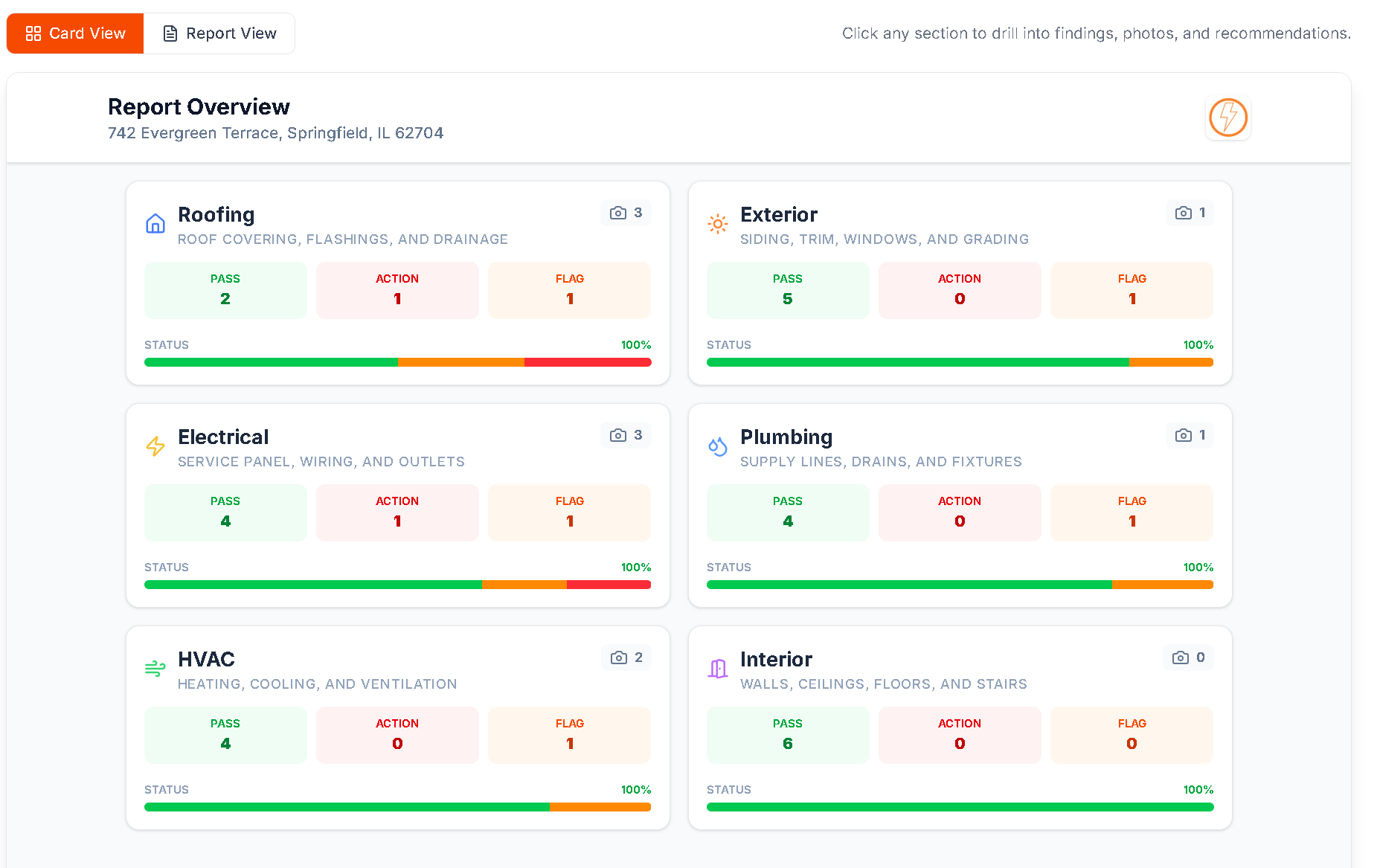
Modern inspection software like InspectForge combines all of these capabilities — AI-powered report writing with MI6 assistant, photo annotation, customizable templates, and mobile apps for iOS and Android — so you can deliver same-day reports that are thorough, professional, and consistent.
Choosing the Right Report Writing Software
When evaluating inspection report software, look for these essential features:
- AI-assisted report writing to reduce writing time and improve consistency
- Native mobile apps (iOS and Android) for on-site data entry and photo capture
- Offline mode for properties with poor connectivity
- Customizable templates that match your workflow and state requirements
- Photo annotation tools built into the mobile app
- Digital agreement and e-signature collection before the inspection
- Scheduling and payment processing to streamline your business operations
- Professional PDF and HTML report output with your custom branding
The right software should cut your report writing time in half while improving report quality and consistency. Look for platforms that offer a free trial so you can test the workflow before committing. InspectForge offers a 14-day free trial with no credit card required, giving you time to experience the full workflow including AI-powered report generation.
Report Writing Best Practices: A Quick Reference
| Best Practice | Why It Matters |
|---|---|
| Deliver reports same-day | Agents prefer fast turnaround — it wins referrals |
| Use 150–300+ photos per report | Visual evidence protects you and informs clients |
| Annotate every deficiency photo | Arrows and highlights eliminate ambiguity |
| Use a severity classification system | Helps clients prioritize repairs |
| Document all limitations | Your best legal protection |
| Include an executive summary | The most-read section of your report |
| Recommend specialists, not repairs | Stay within your scope of practice |
| Use consistent formatting | Professional appearance builds trust |
| Review before sending | Catch copy-paste errors and missing sections |
| Archive all reports | Digital storage for liability protection |
Conclusion
Writing a great home inspection report is both a technical skill and a professional practice. It requires clear communication, thorough documentation, attention to detail, and the right tools. By following the standards set by InterNACHI and ASHI, avoiding common mistakes, and leveraging modern AI-powered software, you can deliver reports that protect your clients, build your business, and set you apart in a competitive market.
The inspectors who invest in their report quality — through better writing, better photos, and better tools — are the ones who earn the most referrals and build the most successful businesses.
Ready to upgrade your report writing workflow? Learn more about how InspectForge's AI-powered platform can help at inspectforge.com.
This guide was last updated in February 2026. For the most current InterNACHI Standards of Practice, visit nachi.org/sop.htm. For ASHI Standards, visit homeinspector.org.