AI in Home Inspection: How Artificial Intelligence is Changing the Industry
AI in Home Inspection: How Artificial Intelligence is Changing the Industry
Artificial intelligence is no longer a futuristic concept for home inspectors — it is here, and it is reshaping how inspections are performed, reports are written, and businesses are run. This guide covers the practical ways AI is transforming the home inspection industry in 2026, what it means for your business, and how to stay ahead of the curve.
The AI Revolution in Home Inspection
The home inspection industry has always been a hands-on profession. Crawling through attics, testing electrical outlets, and documenting roof conditions are physical tasks that require trained eyes and experienced judgment. So where does artificial intelligence fit in?
AI does not replace the inspector. It replaces the tedious, time-consuming work that happens around the inspection — the hours of report writing, the manual photo sorting, the repetitive typing of the same finding descriptions, and the administrative overhead of running a business. By automating these tasks, AI frees inspectors to focus on what they do best: evaluating properties and communicating findings to clients.
In 2026, AI-powered inspection tools are no longer experimental. They are production-ready, field-tested, and delivering measurable results for inspectors who adopt them.
6 Ways AI Is Transforming Home Inspections
1. AI-Powered Report Writing
Report writing has traditionally been the most time-consuming part of an inspection. A typical 3-hour on-site inspection is often followed by 2–4 hours of report writing — selecting photos, typing descriptions, formatting findings, and proofreading. For inspectors doing 2–3 inspections per day, this creates a brutal bottleneck.
AI report writing tools change this equation dramatically. Here is how they work:
- You identify a finding during the inspection (e.g., "cracked foundation wall — east side")
- The AI generates a complete, professional narrative description including severity classification, potential implications, and a recommended action
- You review the AI-generated text, make any adjustments, and move on
What used to take 3–5 minutes per finding now takes 15–30 seconds. Across a report with 30–80 findings, this reduces report writing time by 30–60%.
Real-world impact: Inspectors using AI report writing consistently report delivering same-day reports, which is the single biggest factor in earning agent referrals. Agents want fast turnaround — AI makes it achievable without sacrificing quality.
2. AI Photo Analysis
This is where AI gets truly powerful. Advanced AI can analyze your inspection photos and identify potential deficiencies automatically.
How it works:
- You take a photo of a roof, foundation, electrical panel, or any other component
- The AI analyzes the image and suggests what it sees — cracked shingles, water staining, double-tapped breakers, corroded pipes
- You confirm, adjust, or override the AI's suggestion
- The finding is added to your report with the photo already attached and annotated
This is not about replacing your judgment. It is about catching things faster and ensuring consistency. Even experienced inspectors benefit from a "second set of eyes," particularly during long inspection days when fatigue can cause missed items.
Current capabilities:
- Identifying visible cracks, staining, and deterioration in structural photos
- Recognizing common electrical panel deficiencies
- Detecting moisture patterns and water damage indicators
- Flagging roofing material condition issues
- Identifying plumbing material types and visible defects
Current limitations:
- AI cannot see behind walls, under insulation, or detect concealed conditions
- It works best with clear, well-lit photos
- It supplements — never replaces — inspector expertise and training
- Complex or ambiguous conditions still require human judgment
3. Automated Report Summaries
The executive summary is the most-read section of any inspection report. It is also one of the hardest to write well, because it requires synthesizing an entire report into a concise, prioritized overview.
AI excels at this. After you complete your inspection and all findings are documented, AI can:
- Scan every finding in the report
- Categorize them by severity (safety hazard, major deficiency, minor deficiency, maintenance)
- Generate a structured summary highlighting the most critical items
- Include appropriate disclaimer language
This takes what was a 15–30 minute manual task and completes it in seconds, with consistent quality and formatting every time.
4. AI Template Generation
Every inspector has encountered a property type they do not have a template for — a commercial building, a multi-family unit, a historic property, a modular home. Building a custom template from scratch takes hours of work.
AI template generation lets you describe what you need in plain language:
"Create a template for a 4-unit multi-family residential property with individual HVAC systems, shared electrical service, and common area inspection."
The AI generates a complete template with appropriate sections, checklist items, and finding options tailored to that property type. You review, customize, and save it — a process that takes minutes instead of hours.
5. Smart Scheduling and Business Intelligence
AI is not limited to the inspection itself. It is increasingly applied to the business operations side:
- Scheduling optimization — AI can suggest optimal scheduling based on property location, travel time, inspection complexity, and your availability
- Pricing recommendations — Based on property size, age, location, and your historical data
- Client communication — Automated follow-ups, review requests, and appointment reminders
- Business analytics — Identifying trends in your inspection data, busiest seasons, most common findings, and revenue patterns
6. Quality Control and Consistency
One of the most valuable but underappreciated applications of AI is quality control. AI can review your completed report before delivery and flag:
- Missing sections or incomplete inspections
- Findings without photos
- Inconsistencies between findings (e.g., rating a system as "satisfactory" but including deficiency notes)
- Copy-paste errors from previous reports (wrong address, wrong client name)
- Missing limitation disclosures
This catches mistakes that manual review often misses, especially at the end of a long day.
The Business Case for AI: Numbers That Matter
Here is how AI adoption translates into tangible business outcomes:
| Metric | Without AI | With AI | Impact |
|---|---|---|---|
| Post-inspection report time | 2–4 hours | 30–90 minutes | 50–65% time savings |
| Report delivery | Next day | Same day | Significantly more agent referrals |
| Findings per report | 30–50 | 40–70 | More thorough documentation |
| Reports per day capacity | 1–2 | 2–3 | 50–100% revenue increase potential |
| Administrative time | 5–10 hrs/week | 2–4 hrs/week | More time for inspections or personal life |
Revenue Impact Example
Consider an inspector who currently completes 8 inspections per week at an average fee of $425:
- Current weekly revenue: $3,400
- With AI (10 inspections/week due to time savings): $4,250
- Annual difference: $44,200 additional revenue
And that calculation does not account for the referral growth that comes from faster report delivery and higher report quality.
Common Concerns About AI in Home Inspection
"Will AI Replace Home Inspectors?"
No. AI cannot crawl through a crawlspace, climb a ladder, operate a gas leak detector, or make judgment calls about ambiguous conditions. Home inspection is a physical, on-site profession that requires human expertise, liability, and client interaction. AI is a tool that makes inspectors faster and more consistent — it does not replace them.
The inspectors who should be concerned are not those being "replaced by AI" but those being outcompeted by inspectors who use AI to deliver better, faster service.
"Is AI-Generated Report Text Accurate?"
Modern AI generates text based on industry-standard language and best practices. However, every AI-generated description should be reviewed and approved by the inspector before inclusion in the report. The AI provides a professional starting point — the inspector provides the final judgment.
Reputable AI inspection tools are trained on inspection-specific language and adhere to InterNACHI and ASHI Standards of Practice terminology. They do not hallucinate findings or fabricate conditions — they generate descriptions for findings you have already identified.
"What About Liability?"
The inspector remains liable for the report, regardless of how the text was generated. AI-generated descriptions are tools, just like your moisture meter or thermal camera. You are responsible for verifying the accuracy of every statement in your report.
This is why the best AI inspection tools keep the inspector in control — AI suggests, the inspector approves. Nothing goes into the report without your review and confirmation.
"Is It Too Expensive for a Solo Inspector?"
AI inspection features are typically included in modern inspection software subscriptions, not sold as expensive add-ons. The cost is comparable to what inspectors already pay for report writing software, and the time savings typically pays for the subscription within the first week of use.
"I'm Not Tech-Savvy — Can I Still Use It?"
The best AI tools are designed to be invisible. You do not need to understand machine learning or prompt engineering. You take photos, select findings, and the AI generates descriptions. If you can use a smartphone, you can use AI inspection tools.
How to Evaluate AI Features in Inspection Software
Not all AI features are created equal. Here is what to look for when evaluating AI capabilities in inspection software:
Must-Have AI Features
- AI-generated finding descriptions — The core feature. Should produce professional, Standards-of-Practice-aligned text from your selected finding type.
- Photo integration — AI descriptions should automatically attach to the relevant photos and finding.
- Editable output — You must be able to edit, customize, or override any AI-generated text.
- Offline capability — AI features should work (or gracefully degrade) without internet connectivity.
High-Value AI Features
- Photo analysis — AI that can examine your photos and suggest deficiencies.
- Report summaries — Automated executive summary generation from your findings.
- Template generation — Create custom templates from natural language descriptions.
- Quality checks — Pre-delivery report review for completeness and consistency.
Red Flags
- AI that adds findings you did not identify — The inspector, not the AI, determines what is in the report.
- No ability to edit AI output — You need full control over every word in your report.
- AI that requires constant internet — If it does not work offline, it will fail you in the field.
- Vague "AI-powered" marketing with no specifics — Ask exactly what the AI does before committing.
InspectForge MI6: AI Built for Inspectors
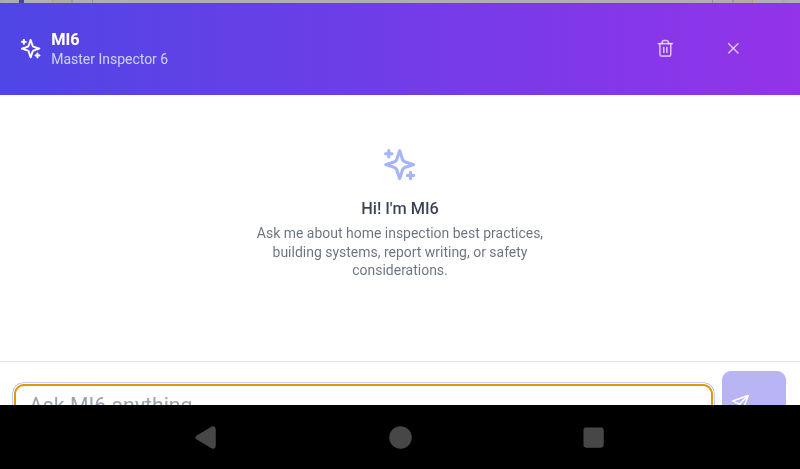
InspectForge built its AI assistant, MI6, specifically for the home inspection workflow. Here is what MI6 handles:
- AI Comment Writing — Select a finding type and MI6 generates a professional narrative description with severity classification and recommended actions
- AI Photo Analysis — Take a photo and MI6 analyzes it to suggest what it sees, helping you document findings faster
- AI Report Summaries — Complete your inspection and MI6 generates a structured executive summary organized by severity
- AI Template Generation — Describe the inspection type you need and MI6 creates a complete custom template with appropriate sections and items
MI6 is available on InspectForge's Pro and Business plans, with AI summaries on Pro and the full AI suite (including photo analysis and template generation) on Business. All features work through the native iOS and Android mobile apps.
Learn more about InspectForge's AI capabilities in the documentation or start a 14-day free trial.
The Future: What Is Next for AI in Home Inspection?
The current generation of AI inspection tools focuses on report writing efficiency and photo analysis. Here is what the next 2–3 years are likely to bring:
- Predictive maintenance recommendations — AI that cross-references equipment age, manufacturer data, and climate conditions to predict when systems are likely to fail
- Automated code reference — AI that identifies which building code edition applies to a component based on the home's construction date and jurisdiction
- Voice-to-report — Dictate findings in natural language while inspecting, and AI converts your spoken observations into formatted report entries
- Drone integration — AI-powered drone flights that automatically photograph and analyze roof conditions
- Cross-report analytics — AI that identifies patterns across your inspection history, helping you spot regional trends and common deficiencies
Conclusion
AI is not coming to the home inspection industry — it is already here. The inspectors who adopt AI tools today are delivering reports faster, catching more deficiencies, growing their businesses, and earning more referrals. Those who wait risk falling behind competitors who leverage these tools to provide a measurably better service.
The key is to approach AI as what it is: a powerful tool that amplifies your expertise, not a replacement for it. Your training, your experience, your judgment, and your on-site skills remain irreplaceable. AI simply removes the bottlenecks that have always slowed you down.
Start with the basics — AI report writing and photo analysis — and let the time savings speak for themselves. Your first same-day report delivery will make the value crystal clear.
This article was last updated in February 2026. AI capabilities in inspection software are evolving rapidly. Features described reflect the current state of available tools.