Why Home Inspectors Are Leaving Spectora for AI-Powered Alternatives
Why Home Inspectors Are Leaving Spectora for AI-Powered Alternatives
Spectora built its reputation on clean, modern reports that agents love. So why are inspectors increasingly exploring alternatives? The answer comes down to three forces reshaping the industry in 2026: AI, pricing pressure, and corporate consolidation. Here is what is driving the shift — and what it means for your business.
The Spectora Story: What Made It Popular
Before examining why inspectors are leaving, it is worth understanding what made Spectora successful in the first place.
Spectora entered the home inspection software market with a clear value proposition: modern, clean HTML reports that looked professional and were easy for agents and buyers to navigate. At a time when most inspection reports were dense PDFs with small fonts and poor formatting, Spectora's interactive reports were a genuine leap forward.
Key strengths that built Spectora's user base:
- Interactive HTML reports with clickable sections, severity filtering, and embedded photos
- Create Request List (CRL) that agents could use to generate repair requests
- Clean, modern interface compared to legacy platforms
- Agent-facing marketing tools that helped inspectors build referral relationships
- Business analytics that gave inspectors visibility into their performance
These features earned Spectora a loyal following, particularly among inspectors who prioritize agent relationships and report presentation. Many inspectors built their businesses around the Spectora workflow and report format.
So what changed?
The Three Forces Driving Inspectors Away
Force 1: The AI Gap
This is the single biggest factor. AI-powered inspection tools have gone from experimental to essential in 2026, and Spectora has not kept pace.
What AI-powered alternatives now offer:
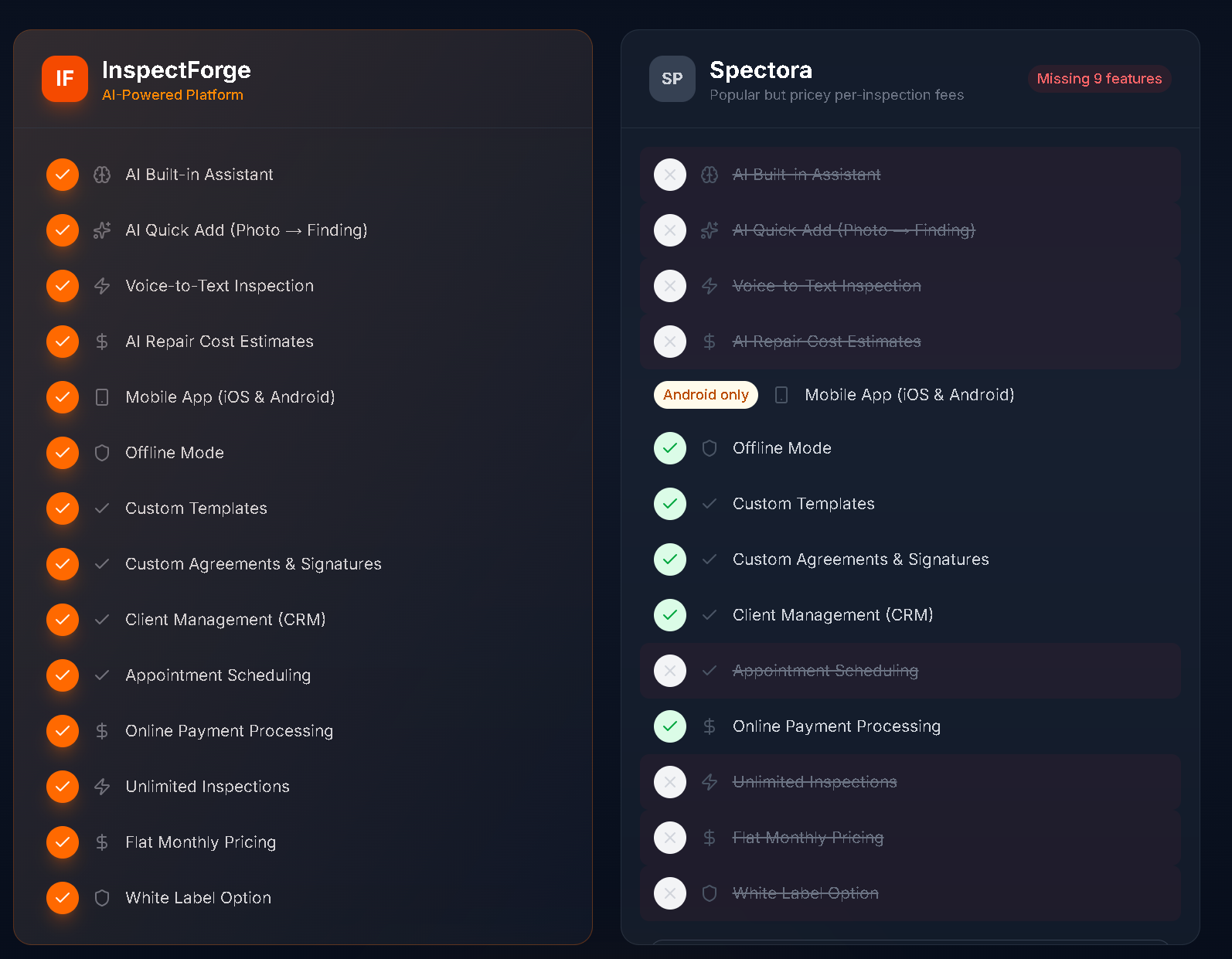
- AI comment generation — Select a finding type and get a professional, detailed narrative instantly. No typing, no searching through comment libraries.
- AI photo analysis — Upload an inspection photo and the AI identifies and describes what it sees: damaged shingles, corroded plumbing, improper wiring, moisture patterns.
- AI report summaries — Automatic executive summaries organized by severity that help clients and agents quickly understand the most important findings.
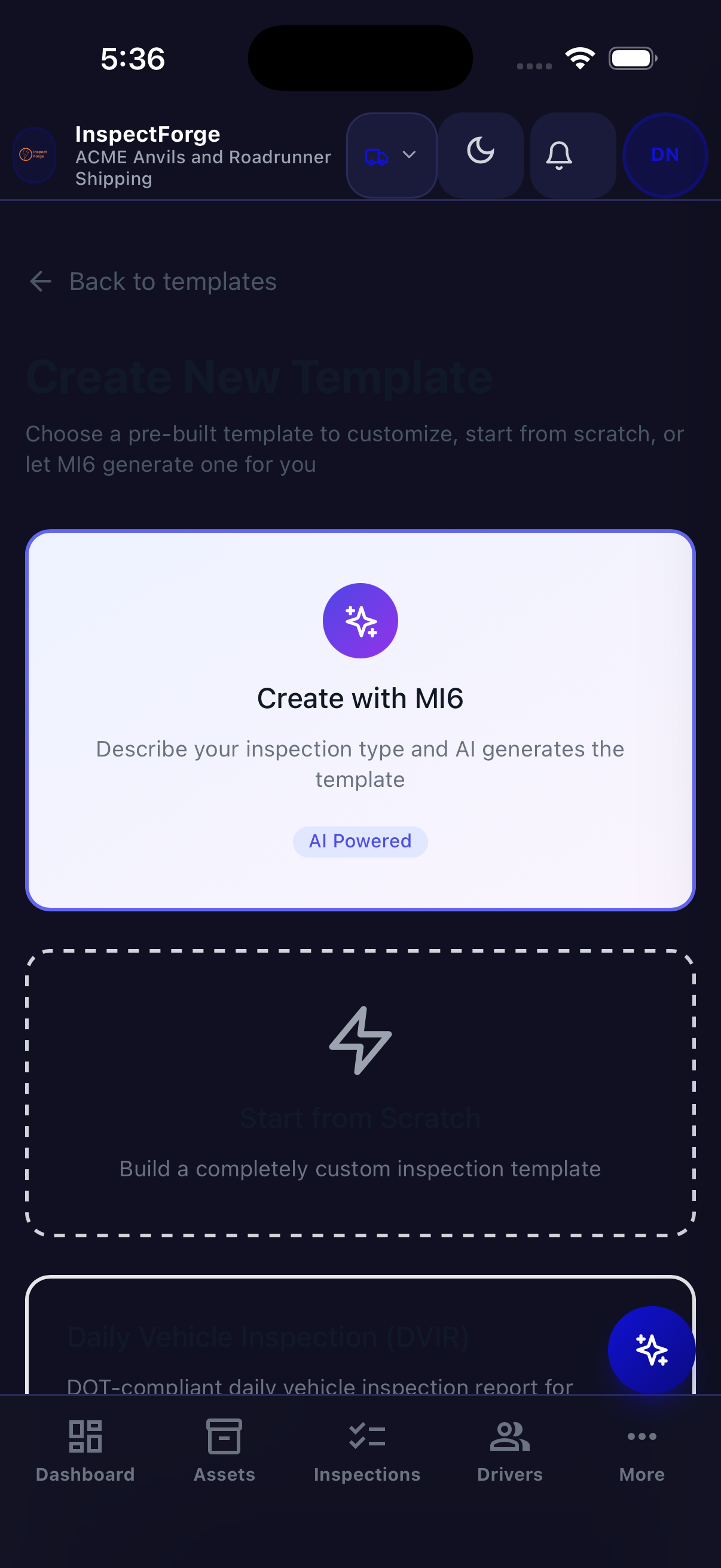
- AI template generation — Describe an inspection type in plain language and receive a complete, ready-to-use template.
What Spectora offers:
- Limited AI text assistance on certain plans
- No AI photo analysis
- No AI report summaries
- No AI template generation
The practical impact is stark. Inspectors using full AI suites report cutting their post-inspection report writing time from 2–3 hours to 30–60 minutes. Over 20 inspections per month, that is 30–50 hours of time recovered — time that can be spent doing more inspections, marketing, or simply going home earlier.
Here is what inspectors are saying in online communities:
"I switched to AI-powered software three months ago and I cannot imagine going back. What used to take me two hours after every inspection now takes 30 minutes. I am delivering same-day reports consistently for the first time in my career."
"The AI photo analysis caught a foundation crack I had already noted but described it with technical detail I would have spent five minutes writing. It is like having a second set of eyes that writes better than I do."
"My agent referrals went up after I started delivering reports within four hours instead of next day. Same quality — faster delivery. AI made that possible."
Force 2: Per-Inspection Pricing at Scale
Spectora's per-inspection pricing was attractive when the platform launched and inspectors were doing 8–12 inspections per month. In 2026, the economics have shifted.
The math that is pushing inspectors to reconsider:
Many working inspectors now perform 20–30+ inspections per month. At Spectora's Advanced plan ($109/month base + approximately $3 per report):
| Monthly Volume | Spectora Cost | Flat-Rate Alternative | Difference |
|---|---|---|---|
| 15 inspections | $154/mo | $39–$69/mo | $85–$115 saved |
| 20 inspections | $169/mo | $39–$69/mo | $100–$130 saved |
| 25 inspections | $184/mo | $39–$69/mo | $115–$145 saved |
| 30 inspections | $199/mo | $39–$69/mo | $130–$160 saved |
| 40 inspections | $229/mo | $69–$99/mo | $130–$160 saved |
Annual impact: At 20 inspections per month, an inspector pays approximately $2,028/year on Spectora versus $468–$828/year on a flat-rate subscription alternative. That is $1,200–$1,560 in annual savings — enough to cover a new thermal camera, marketing budget, or several months of business expenses.
The frustration is not just the total cost. It is the psychology: every time you win a new client, your software bill goes up. The per-inspection model creates a perverse incentive where growth costs you more. Flat-rate subscriptions reward growth — the more inspections you do, the lower your per-inspection software cost.
Force 3: The EQT Partners Acquisition
In 2024, private equity firm EQT Partners acquired both Spectora and HomeGauge, placing the two largest home inspection software platforms under a single owner.
This is not inherently bad, but it has triggered legitimate concerns in the inspector community:
Concern: Reduced competition leads to higher prices. When the top two platforms are owned by the same company, there is less competitive pressure to keep prices low or improve features aggressively. Inspectors worry — reasonably — that pricing will increase once the dust settles.
Concern: Feature convergence and forced migration. Will Spectora and HomeGauge eventually merge into a single platform? If so, will users be forced to adapt to new workflows, potentially losing customizations and templates?
Concern: Innovation takes a back seat to profitability. Private equity firms typically acquire companies to optimize profitability over a 3–7 year holding period. This often means cost-cutting, price increases, and reduced R&D investment. Inspectors worry that the pace of innovation on Spectora will slow.
Concern: Loss of independent voice. When a company is owned by private equity, the incentive structure shifts from "make the best product for users" to "maximize returns for investors." These goals sometimes align, but not always.
These concerns have motivated many inspectors to diversify away from the Spectora/HomeGauge ecosystem and toward independent platforms that are still founder-led and innovation-driven.
What Inspectors Actually Want in 2026
Based on inspection community discussions, industry surveys, and our conversations with thousands of inspectors, here are the capabilities that define a competitive inspection platform in 2026:
1. AI That Actually Works
Not marketing buzzwords — functional AI that reduces post-inspection work. Specifically:
- Comment generation that produces professional narratives you would actually publish without editing
- Photo analysis that identifies deficiencies accurately and describes them in technical language
- Summary generation that creates client-friendly executive summaries organized by priority
- Template creation that lets you build custom templates from a description instead of hours of manual setup
2. Native Mobile That Does Not Fail On-Site
Inspectors spend 80–90% of their working time on-site. The mobile app is not a companion feature — it is the primary interface. Requirements:
- True native app (not a responsive website in a browser wrapper)
- Full offline mode that works in basements, crawlspaces, and rural properties
- Fast photo capture with native camera integration
- On-device annotation (arrows, circles, text) without waiting for uploads
- Auto-sync when connectivity returns
Spectora's web-based mobile experience works, but it carries inherent browser limitations: slower photo processing, potential state loss during long inspections, and reduced offline capability.
3. Predictable, Growth-Friendly Pricing
The industry is clearly moving toward flat-rate subscription models. Inspectors want to know exactly what their software costs every month, regardless of volume. The per-inspection model made sense when the industry was smaller and inspectors did fewer inspections. In 2026, it is a competitive disadvantage.
4. All-in-One Business Management
Inspectors are tired of managing separate tools for scheduling (ISN), reports (Spectora), invoicing (QuickBooks), and agreements (DocuSign). The platforms winning market share in 2026 combine everything:
- Inspection reports
- Scheduling and calendar management
- Online booking
- Digital agreements with e-signatures
- Payment processing
- Client management
5. Platform Independence
After the Spectora/HomeGauge acquisition, many inspectors now consider platform ownership as a factor. An independent, founder-led company has different incentives than a portfolio company owned by a financial buyer.
The AI Advantage: What It Looks Like in Practice
To understand why AI is driving the migration away from Spectora, here is what a typical inspection workflow looks like with and without AI assistance.
Without AI (Typical Spectora Workflow)
- On-site (3–4 hours): Walk the property, take photos, enter basic notes in the app, select pre-written comments where available
- Post-inspection report writing (1.5–3 hours):
- Return to desktop (or continue on mobile)
- Review each finding and write or customize the narrative
- Search through comment libraries for relevant pre-written text
- Type custom descriptions for unusual findings
- Write an executive summary manually
- Review the entire report for consistency
- Report delivery: Send the report link to the client and agent
- Total time per inspection: 5–7 hours (including on-site)
With AI (Modern AI-Powered Workflow)
- On-site (3–4 hours): Walk the property, take photos, enter findings — AI begins generating comment narratives in real time as you select finding types
- Post-inspection review (30–60 minutes):
- Review AI-generated narratives — edit only where needed (most are publish-ready)
- AI generates executive summary automatically from your findings
- Quick review for accuracy and completeness
- Report delivery: Send the report
- Total time per inspection: 3.5–5 hours (including on-site)
If you inspect in a state with strict summary-control rules, this is usually where the question turns from "how much time does it save" to "how much of the wording am I handing over." That tradeoff is worth reading about before you switch — can home inspectors use AI in reports covers how licensed inspectors are drawing that line, and why every AI feature should be a separate switch you control.
The Compounding Effect
| Metric | Without AI | With AI | Impact |
|---|---|---|---|
| Post-inspection time | 1.5–3 hours | 30–60 minutes | 1–2 hours saved per inspection |
| Monthly time saved (20 insp.) | — | 20–40 hours | 2.5–5 full working days |
| Same-day delivery rate | ~30% | ~80–90% | More agent referrals |
| Report consistency | Variable | Highly consistent | More professional brand |
The 20–40 hours saved per month is not abstract. It represents real capacity: 4–8 additional inspections you could perform (at $300–$500 each, that is $1,200–$4,000 in additional monthly revenue), or 20–40 hours of marketing, family time, or rest.
Who Is Actually Switching? Inspector Profiles
The Growth-Focused Inspector
Profile: 3–7 years in business, doing 20–30 inspections per month, looking to scale to 35–50. Why they leave Spectora: Per-inspection fees become a significant line item at higher volumes. They need AI to handle the report writing bottleneck that prevents them from doing more inspections per day. They want flat-rate pricing that rewards growth rather than penalizing it.
The Efficiency-Driven Solo Inspector
Profile: 5–15 years in business, doing 15–25 inspections per month, wants to work less while maintaining income. Why they leave Spectora: AI report writing cuts post-inspection time by 60–70%, letting them finish their workday earlier without sacrificing report quality. They value time savings over doing more inspections.
The New Inspector
Profile: 0–2 years in business, building their practice, watching every dollar. Why they skip Spectora entirely: New inspectors researching software in 2026 see AI-powered alternatives at $39/month versus Spectora at $109+/month with per-inspection fees. The value proposition is clear from day one. Many never consider per-inspection pricing models.
The Multi-Inspector Firm
Profile: 2–10 inspectors, doing 40–100+ inspections per month. Why they leave Spectora: At scale, per-inspection fees are devastating. A 5-inspector team doing 100 inspections per month pays approximately $409/month on Spectora ($109 + $300 in per-inspection fees) versus $99/month on a flat-rate Business plan. That is $3,720/year in savings — plus the AI efficiency gains multiplied across every inspector on the team.
What About Spectora's Strengths?
This article would not be balanced without acknowledging where Spectora still leads.
Interactive HTML Reports
Spectora's interactive reports remain the best-looking in the industry. The ability for agents and clients to click through sections, filter by severity, and view embedded photos in a clean web interface is genuinely excellent. No other platform has fully matched this experience.
However: The importance of report format is decreasing relative to report speed and content quality. Agents increasingly value same-day delivery over interactive formatting. A fast, AI-enhanced PDF with a clear executive summary is competing effectively against a slower, prettier HTML report.
Create Request List (CRL)
Spectora's CRL feature lets agents select findings and generate a repair request document. This is a valuable agent-facing tool that some agents have come to rely on.
However: Not all agents use CRL, and many are not aware it exists. If your agents do not specifically request CRL, its absence on an alternative platform is not a practical loss.
Established Brand and Agent Recognition
Some agents specifically recommend Spectora to their inspectors, creating a referral ecosystem. Switching platforms can feel risky if your agent relationships are tied to the Spectora brand.
However: Agent loyalty follows inspector quality, not software brand. Inspectors who switch to faster, AI-powered platforms and deliver same-day reports consistently find that agent referrals increase, not decrease.
How to Evaluate Whether It Is Time to Switch
Ask yourself these questions:
Cost Questions
- What is my true monthly Spectora cost (base + per-inspection fees + any add-ons)?
- How does that compare to a flat-rate alternative at my current volume?
- If I grow to 30, 40, or 50 inspections per month, what will Spectora cost then?
Productivity Questions
- How many hours per week do I spend on post-inspection report writing?
- Would AI report writing meaningfully reduce that time?
- Am I consistently delivering same-day reports, or is report writing the bottleneck?
Business Questions
- Am I comfortable with my software being owned by a private equity firm?
- Do my agents specifically require Spectora's CRL or interactive report format?
- Is my current software helping me grow, or just maintaining the status quo?
If the cost is higher than you would like, the post-inspection time is longer than it needs to be, and your agents do not specifically require Spectora features, then it is worth exploring AI-powered alternatives with a free trial.
The AI-Powered Alternative: InspectForge
InspectForge is the platform most frequently cited by inspectors switching from Spectora. Here is why:
- MI6 AI Suite: Comment generation, photo analysis, report summaries, and template creation — the most comprehensive AI feature set in inspection software
- Flat-rate pricing: $39/month (Starter), $69/month (Pro), $99/month (Business) — no per-inspection fees
- Native mobile apps: True native iOS and Android apps with full offline mode
- All-in-one platform: Reports, scheduling, payments, agreements, and team management in one subscription
- Independent company: Not owned by private equity — founder-led and innovation-focused
Pricing Comparison at a Glance
| Volume | Spectora (Advanced) | InspectForge Pro | Annual Savings |
|---|---|---|---|
| 20/month | $169/mo (~$2,028/yr) | $69/mo ($828/yr) | $1,200/year |
| 30/month | $199/mo (~$2,388/yr) | $69/mo ($828/yr) | $1,560/year |
| 40/month | $229/mo (~$2,748/yr) | $69/mo ($828/yr) | $1,920/year |
Try Before You Commit
InspectForge offers a 14-day free trial with no credit card required. Run a few practice inspections, test the AI features, and see if the workflow fits your business before making any changes to your Spectora subscription.
The Bigger Picture: Where the Industry Is Heading
The migration away from Spectora is part of a broader industry trend:
-
AI is becoming table stakes. Platforms without comprehensive AI features will struggle to compete for new users. Within 2–3 years, AI-powered report writing will be the expectation, not the exception.
-
Per-inspection pricing is dying. As inspection volumes increase industry-wide, per-inspection models become economically irrational. Flat-rate subscriptions that reward growth will dominate.
-
Consolidation creates opportunity for independents. When legacy platforms merge under corporate ownership, agile independent platforms have a window to capture dissatisfied users with better features and pricing.
-
Mobile-native is the new baseline. Web-based mobile experiences are no longer competitive against true native apps, especially for field work where offline reliability is critical.
-
All-in-one platforms win. The era of cobbling together separate tools for reports, scheduling, invoicing, and agreements is ending. Inspectors want one platform that does everything.
Spectora built a great product for the era in which it launched. The question for inspectors in 2026 is whether that product has kept pace with how the industry works today — or whether it is time for something built for what comes next.
Ready to Explore Your Options?
If you are a Spectora user considering alternatives, here is a practical path forward:
- Calculate your true Spectora cost. Add up your base subscription, per-inspection fees, and any additional tools (ISN, etc.) for the last three months. Divide by three for your average monthly cost.
- Start a free trial on an AI-powered alternative. InspectForge's 14-day trial is no-commitment and no credit card.
- Test the AI features. Run a practice inspection and compare the time and quality against your current Spectora workflow.
- Do the math. If the alternative is cheaper, faster, and your agents will not notice (or will benefit from faster reports), the decision makes itself.
Your software should be an investment that scales with you — not a tax on your growth.
Related Reading
- InspectForge vs Spectora: Which Saves You More Money in 2026? — Detailed pricing comparison at every volume level
- Switching from HomeGauge to InspectForge: A Complete Migration Guide — Step-by-step migration guide (applicable concepts for Spectora users too)
- Best Home Inspection Software 2026 — Complete platform comparison
- Spectora vs HomeGauge vs InspectForge — Three-way feature comparison
This article is based on publicly available information, community feedback, and industry analysis as of March 2026. Features and pricing may change. InspectForge is the publisher of this article — while we have aimed for balanced analysis grounded in facts, readers should consider this context. We recommend evaluating any platform with a free trial before making purchasing decisions.